
Chest surgery: Improving scar adherence and tissue contour
Background
This patient underwent a surgical procedure to treat a lung condition, involving small incisions into the chest wall and insertion of a drain.
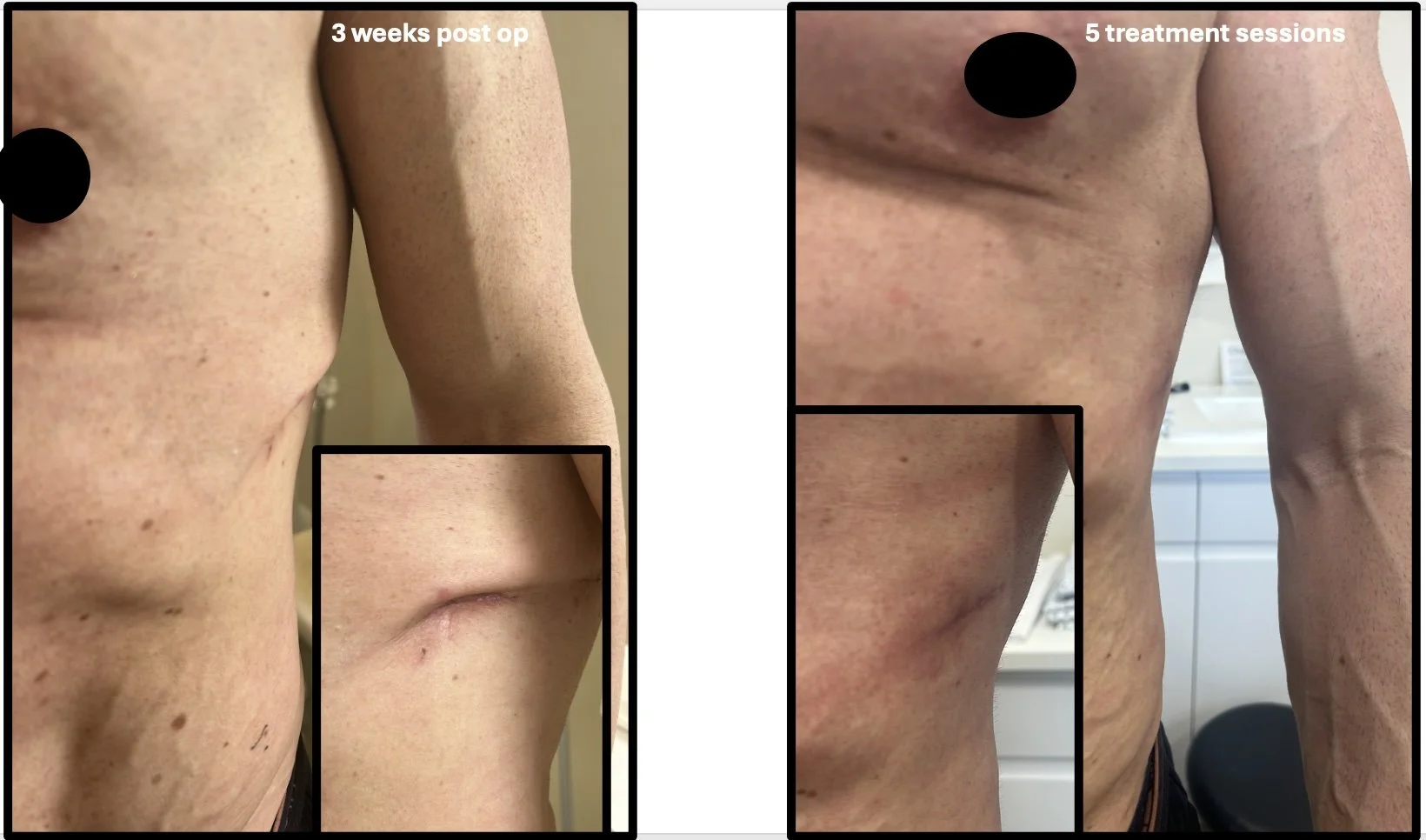
The photographs show the chest viewed from the front, with the nipples covered for privacy. The image on the left was taken at the first assessment, three weeks after surgery, and the image on the right after four treatment sessions. The close-up images highlight the changes in the scar and surrounding tissues.
Presenting problems
The patient's main concern was not the scar itself, but the way it was affecting the contour of his chest.
In the first photograph, the scar is just visible beneath a prominent ridge or overhang of tissue. The scar was pulling the surrounding tissues inwards, creating a deep indentation and an unnatural contour, particularly noticeable when viewed from the side.
He was unhappy with this change in his body shape and wanted to know whether anything could be done.
Clinical assessment and findings
On examination, the scar was extremely adherent (firmly attached to the underlying tissues). When the surrounding tissues were gently glided over the underlying structures, there was no movement at all.
This complete lack of tissue mobility was responsible for the pronounced tethering and distortion of the surrounding tissue. The close-up image on the left illustrates how deeply the scar was drawn inwards.
Despite being only three weeks after surgery, the adherence was already substantial.
Scar management
Treatment focused on mobilising the scar and surrounding tissues initially manually and then with additional LPG to improve tissue mobility and reduce the tethering responsible for the altered contour.
Outcomes
After four treatment sessions, there was a clear improvement in scar mobility and a reduction in the tissue overhang.
In the photograph on the right, the chest contour is considerably smoother, with a more natural flow of the surrounding tissues. The close-up image shows that the scar is now sitting much more flush with the surrounding skin, rather than being pulled deeply inwards.
On examination, the tissue was also noticeably more pliable and mobile.
The patient was particularly pleased with this change, as it addressed the aspect of the scar that had concerned him most.
Treatment is continuing, with the aim of achieving further improvements.
What can we learn from this case?
Focus on what matters to the patient. A scar may not be the person's main concern. In this case, the patient was comfortable with having a visible scar but was unhappy with the distortion of the surrounding tissue. Understanding his priorities helped guide treatment towards an outcome that mattered to him.
Early specialist assessment can make a difference. This patient recognised the problem and sought help just three weeks after surgery. Although the scar was already extremely adherent, treatment was started while the tissues were still in an early stage of healing and remodelling. Had the adherence remained untreated for several months, achieving the same improvement with non-invasive treatment may have been considerably more difficult.
Adherent scars can be challenging to treat. Not all adherent scars respond sufficiently to non-invasive treatment, and it can be difficult to predict the outcome. Some may require surgical release or other specialist interventions. Where surgery is needed, appropriate scar rehabilitation before and after the procedure may also help optimise tissue mobility and recovery.