
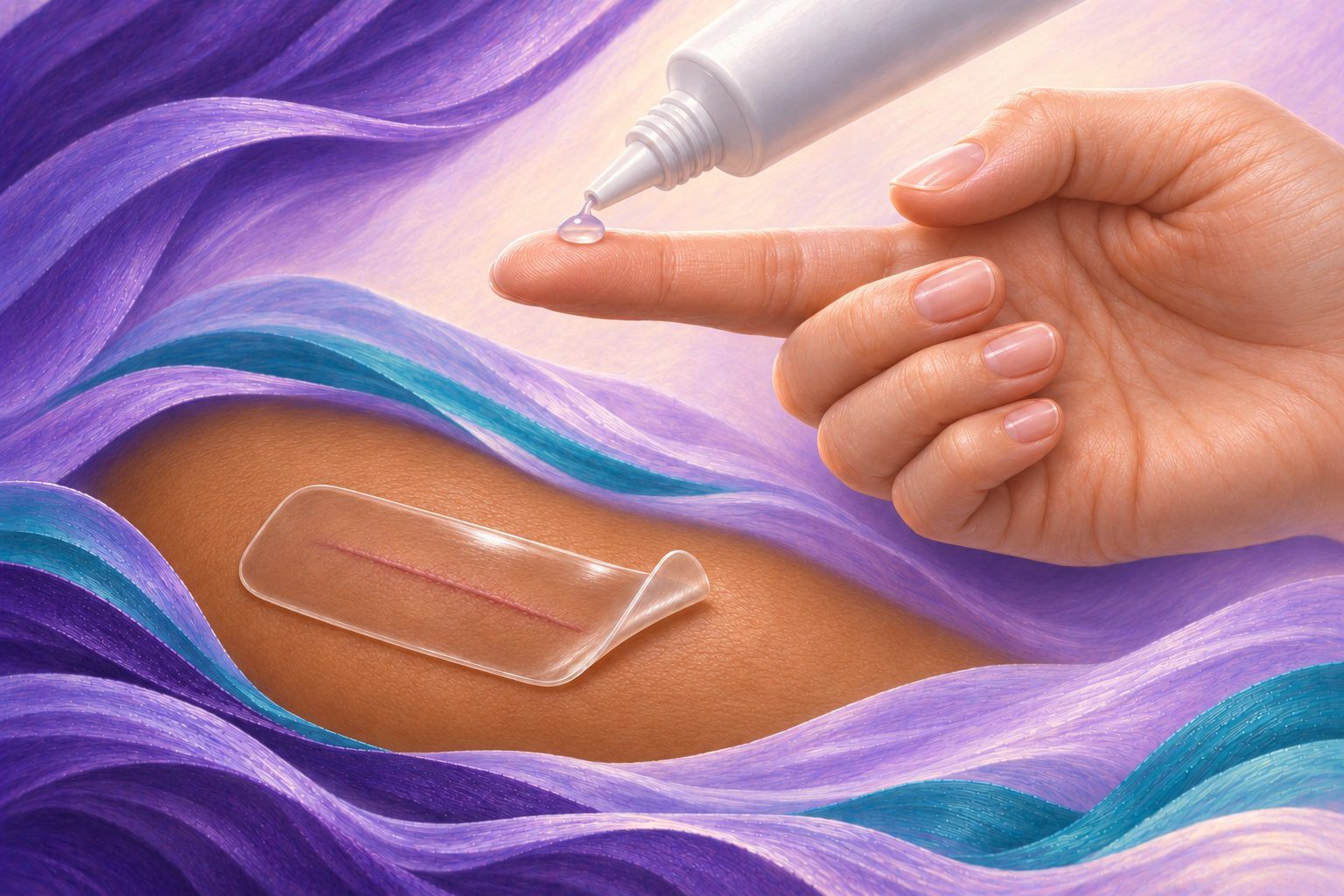
If you’ve been looking for something to help your scar, you’ve probably come across silicone. Gels, sheets, tapes, sprays - sometimes accompanied by impressive photographs and promises of “scar removal”.
So, should you be using it? Does it matter which product you choose? And what can it realistically do?
I use silicone regularly in my practice, particularly with newly healed surgical scars and lacerations. Used selectively, I find it can make a worthwhile difference. But it isn’t essential for every scar, and choosing the right product is only part of the decision. How you use it, how your skin responds and what you’re hoping to improve matter too.
What is silicone?
Silicone is a family of manufactured materials used in many medical products. In scar care, it can form a thin film over the skin or be made into a flexible sheet or a mould that fits a particular area.
The word “silicone” doesn’t mean that every product is the same. Formulations, thickness, flexibility, backing materials, adhesives and additional ingredients vary. These differences can affect how comfortable a product feels, whether it stays in place and how your skin tolerates it.
For this article, we’re talking about silicone products intended for scar treatment on healed skin. Silicone is also used in wound dressings, but those have different purposes and instructions. They shouldn’t be confused.
How does it work? Think of the skin’s barrier as a roof
Your skin has an outer barrier that helps regulate water loss. After an injury, the surface may have closed while this barrier is still recovering.
Imagine a roof whose covering has been damaged. It may look largely repaired, but gaps remain. With skin, the important leak is water escaping outwards: newly healed skin can lose moisture more readily than healthy skin.
Silicone acts rather like a temporary covering over that roof, helping to reduce the water escaping while the skin’s own barrier recovers.
This matters because the outer skin communicates with the scar-forming cells underneath. Experimental research suggests that improving hydration can alter those signals and may help moderate excessive scar formation.
Silicone doesn’t supply water in the way a moisturiser can. It mainly helps the skin retain its own moisture. Suitable moisturisers can support hydration too, although different products achieve this in different ways.
The aim is a better-balanced skin environment. Skin that becomes soggy, irritated or damaged needs a change of approach.
What does the research tell us?
Silicone has been recommended in scar management guidelines for many years as a first-line, non-invasive option. Some studies report improvements in scar height, suppleness, appearance and symptoms.
However, the evidence is less certain than its widespread use (and some advertising) might suggest.
Cochrane reviews have highlighted small studies, poorly reported methods and uncertainty about the benefits of silicone sheets for established hypertrophic scars and keloids. Reviews of gels include encouraging findings, particularly following surgery, but results vary between studies and outcomes.
The earlier Cochrane review (Cochrane is an independent organisation that reviews healthcare research to assess what it tells us and how reliable it is) also identified potential bias associated with manufacturer funding or product supply in several trials. Company involvement doesn’t automatically invalidate research, but it makes independent, well-designed studies particularly important.
Research also combines different scars, products, treatment schedules and comparison treatments. Some studies assess appearance, others symptoms, and relatively few tell us enough about the difference treatment makes to everyday life. How consistently people use a product and the advice they receive can also affect how applicable the findings are.
This doesn’t establish that silicone is ineffective. It does mean we should be realistic about what we can promise.
Professionals interpret this evidence differently. In my practice, I continue to use silicone selectively, considering the research alongside the scar in front of me, your priorities and your response.
What am I hoping it will improve?
My main reasons for recommending silicone are to support hydration and help manage redness, raised scarring or discomfort.
I also often use it preventively on newly healed surgical scars and lacerations. I often don’t wait for the scar to become red or raised before recommending it.
Depending on the scar, we may be aiming for:
Improvement in redness.
A flatter or more supple scar.
Less itch or discomfort.
Protection from irritating contact with clothing.
Those are treatment aims, rather than guaranteed results. Redness is often a particular focus in my practice, although research findings are more consistent for some characteristics than others. Redness is also different from changes in skin pigmentation.
Sometimes the most valuable benefit is very practical. If a bra strap or swimsuit repeatedly rubs a sensitive scar, an appropriate sheet may make that contact more comfortable and allow you to do something you’ve been avoiding.
Desensitisation may also be helpful. Protection and gradually rebuilding tolerance to touch can both have a place, depending on what you need.
Does the type of scar matter?
Yes. Silicone is most relevant to developing scars, particularly those at risk of becoming raised and thickened.
It won’t fill a depressed scar or replace missing tissue. Pitted acne scars and other atrophic scars generally need a different approach. Raised scars caused by acne are a separate situation.
Keloids also need their own consideration. These grow beyond the boundaries of the original injury. The evidence for silicone in established keloids remains uncertain, and I don’t use it to treat existing keloids in my practice.
After surgical removal of a keloid, the situation is different. Silicone may be appropriate as part of a specialist plan to reduce the risk of recurrence.
Gel, sheet or something else?
Silicone gel from a tube
Gel dries into a thin, usually transparent film. It can be particularly practical on the face, around joints, on small area scars or where a sheet would be difficult to secure.
It is also less visible, which matters to some people. Others prefer to cover their scar for a while. That preference deserves consideration too.
Some silicone gels (liquids and sheets) include SPF. These may be convenient, but it is still important to consider your overall sun protection. In my practice, even when a silicone gel contains SPF, I usually recommend applying a separate sunscreen over it once the gel has dried.
Silicone sheets
Sheets provide a covering that stays in contact with the scar. Where they fit well and remain in place, I often favour them in my practice.
That is a clinical and practical preference; research hasn’t established that sheets are consistently better than gel.
There are also sheets shaped for particular areas, including caesarean and breast surgery scars. These can make application easier and help provide more complete, consistent coverage of the scar.
Some people use a sheet at night and gel during the day. Where appropriate, a sheet can be used under an existing pressure garment, a suitable support or tape. Securing it shouldn’t create excessive pressure or restrict circulation.
With young children, loose sheets can present a chewing or swallowing risk. Product choice and safe retention need particular care.
Moulded silicone
A therapist can make a silicone mould, sometimes using a material such as Otoform, to fit an awkward contour or a hollow where a flat sheet won’t make good contact.
These moulds may be used with a garment or splint as part of a specialist plan.
For an example of how I use this approach, see my real-life story about a foot degloving injury.
What about taping?
Tapes need a little clarification. A silicone scar tape, a medical tape with a silicone adhesive, ordinary paper tape and kinesiology tape are different products.
Paper tapes, such as Micropore, can be a cheaper option. Some research on surgical scars has found broadly similar measured outcomes between paper tape and silicone sheets, although this doesn’t establish that they work equally well for every scar.
Suitable tapes may also help reduce water loss through the skin. Depending on the material and how they are positioned, they can support the skin and reduce tension across a developing scar.
That support can matter because repeated pulling on a developing scar can influence how it forms.
Some elastic or kinesiology tapes, as well as other tapes, may be used for this purpose. The choice and application matter: stretching a tape more doesn’t necessarily make it more helpful.
If reducing tension is the aim, ask someone experienced in scar care to show you how. Tapes can irritate or damage fragile skin, particularly during removal, and shouldn’t automatically be treated as interchangeable.
When can I start?
The wound needs to be fully healed before using the scar products discussed here. There should be no open, weeping, broken or scabbed areas.
If you’ve had surgery or another procedure, follow your treating team’s instructions.
Even after the surface has healed, the new skin may be fragile. Sometimes I allow a further week or two before introducing silicone, focusing on appropriate skin care first. That is a decision about the condition of the skin, rather than a waiting period everyone needs.
If your skin is fully healed and robust, and you have no restrictions or known sensitivity, trying a silicone product intended for your type of scar can be reasonable. A pharmacist or treating professional can help if you’re unsure.
How do I use it properly?
Follow the instructions for the product you have. Similar-looking products can require different routines.
For many gels, the important points are:
Apply a very thin, even layer to clean, dry skin.
Allow it to dry before dressing.
Use the recommended frequency - often once or twice daily.
Apply sunscreen or cosmetics afterwards, where the instructions allow.
I often suggest starting with an amount about the size of a grain of rice on your fingertip. Spread it gently across the scar as far as it will go. If more is needed, use another small amount and repeat until you have a thin, even covering.
More gel isn’t better. If it remains wet or sticky beyond its expected drying time, you may have used too much.
Even when a silicone gel contains SPF, I usually still advise a separate broad-spectrum sunscreen over the dried gel, alongside shade and clothing. Follow the instructions for both products; their SPF numbers don’t add together.
For sheets, gradually build up wearing time as instructed, checking the skin regularly. Some can eventually be worn for most of the day and night; others have different schedules.
Reusable gel sheets often need washing with mild soap and water and careful drying. Some adhesive scar dressings have different cleaning instructions, so don’t assume every sheet should be washed in the same way.
Keep reusable sheets somewhere clean and safe between uses. Replace the product according to its instructions and condition. A sheet that becomes damaged or difficult to clean needs replacing. Loss of stickiness alone doesn’t always mean it has stopped working, provided it can still be safely held in contact with the skin.
Combining silicone with moisturisation and massage
Because silicone helps retain moisture, you may find you need to moisturise the covered area less frequently. Moisturising during planned breaks for washing and reapplying silicone may be enough, depending on how your skin feels. This can make care less disruptive, particularly with large areas or scars that are difficult to reach. Before reapplying silicone, follow its instructions about clean, dry skin and removing cream residue.
If massage is part of your treatment plan, suitable techniques may be performed over a silicone sheet or dried silicone gel. Your therapist can show you how, taking account of your scar and product. This may avoid removing and reapplying silicone every time massage is needed.
What if my skin reacts?
Silicone should not make your scar increasingly uncomfortable.
Remove it if you notice a new rash, increased redness, irritation, blistering, broken skin or skin becoming white and soggy. That sogginess is sometimes called maceration.
A reaction doesn’t necessarily mean you are allergic to silicone. Moisture, sweating, friction, adhesives or another ingredient may be involved.
Let the skin settle and discuss the next step with your treating professional, if you have one. You may need shorter wearing periods, a different product, a break or to stop altogether.
Spreading redness, increasing heat or pain, discharge or feeling unwell needs medical advice.
How long should I give it?
Think in months rather than days.
For a suitable product that your skin tolerates, around three months is a reasonable initial trial, with earlier checks for comfort and skin response.
At that point, consider what you were trying to improve. Is the scar more comfortable? Less red or raised? Is the benefit worth the cost and daily effort?
Silicone is only one treatment option. A three-month trial doesn’t mean doing nothing else: other treatments may help alongside it, or another approach may deserve the main focus.
Some people continue for six months or longer while the scar remains active and treatment appears useful. There isn’t one proven maximum duration that suits everyone.
You don’t need to keep buying it indefinitely simply because a scar is still visible. Equally, you shouldn’t wait three months to review something that is causing problems.
What about older scars?
The condition of the scar matters more than its birthday.
Six or twelve months isn’t a reliable dividing line. Some scars are still changing, raised or symptomatic beyond that point.
For a fully mature scar that is flat, settled and comfortable, silicone is less likely to offer a worthwhile change. If an older scar remains raised or troublesome, it is better to assess the problem and consider the treatment options than assume either that silicone will help or that nothing can.
Does every part of a large scar need silicone?
No.
For extensive scarring, covering every area can become expensive, time-consuming and difficult to manage. I would usually prioritise appropriate moisturisation and consider whether particular areas might benefit from silicone.
A targeted approach may be more useful than treating every centimetre in the same way.
Silicone sprays are another option and can be practical for covering larger areas. My experience with them has been mixed, so I would still consider the particular product, how reliably it can be applied and whether it is helping.
Some research suggests that certain moisturisers can support hydration as well as, or better than, particular fluid silicone products. Much of this work measures hydration and water loss over short periods, so it doesn’t establish that all moisturisers and silicone products produce the same long-term scar improvements.
Cost matters even when a treatment is relatively low risk. So does the time and attention it takes from other rehabilitation, work, family and everyday life.
Choosing a product you can trust
There are now so many products and companies making silicone gels and sheets that choosing can feel overwhelming.
I would be cautious about any product promising to “remove” a scar.
Scars naturally change as they mature. Many become flatter and less red without treatment, so an impressive before and after photograph doesn’t tell us how much improvement came from the product - or whether other treatments were involved.
Look for a product intended for scar care, with clear instructions, identifiable ingredients and a manufacturer you can contact. If research is quoted, it should be possible to find out what was studied and what it actually showed. A small uncontrolled study of a combined product is different from a well-designed comparison trial.
You shouldn’t need to become a researcher to choose your scar care. An experienced professional can help you weigh the claims against your needs and budget.
Can I get silicone on prescription?
It is worth asking your GP or treating team whether a suitable silicone product can be supplied or prescribed.
Access varies. Many local NHS prescribing policies now restrict silicone because of uncertainty about its effectiveness and cost-effectiveness, reflected in reviews such as Cochrane. It may therefore not be available to you on prescription, and you may need to buy it independently.
If cost is a concern, mention it to your health care professional. Choosing a more affordable option, treating selected areas or considering alternatives can all be part of the discussion.
So, what would I suggest?
Silicone can be useful early on, once the wound has fully healed, to help prevent raised scarring. You don’t necessarily need to wait for a problem to develop. It may also help a scar that is already red, raised or itchy.
Choose a suitable product that fits your life, follow its instructions and check how your skin responds. If it is comfortable and well tolerated, give it around three months before reviewing its value. Continue appropriate moisturisation and sun protection too.
For large areas or complex scars, seek advice about where silicone could add the most benefit. For an older, settled scar, another approach may be more useful.
The aim is to prevent problems where possible and improve those that develop. Silicone can play a worthwhile part - but it should be chosen for your scar, used consistently and considered alongside any other treatments that may help your scar.