
Background
This patient sustained a deep burn, primarily affecting her neck and face. She was referred to me for scar rehabilitation following her discharge from hospital.
As with all these real-life stories, it is not possible to cover every aspect of assessment and treatment. Her care involved a wide range of treatments; this account focuses mainly on improving neck movement and the effect of the neck scarring on her lower eyelids.
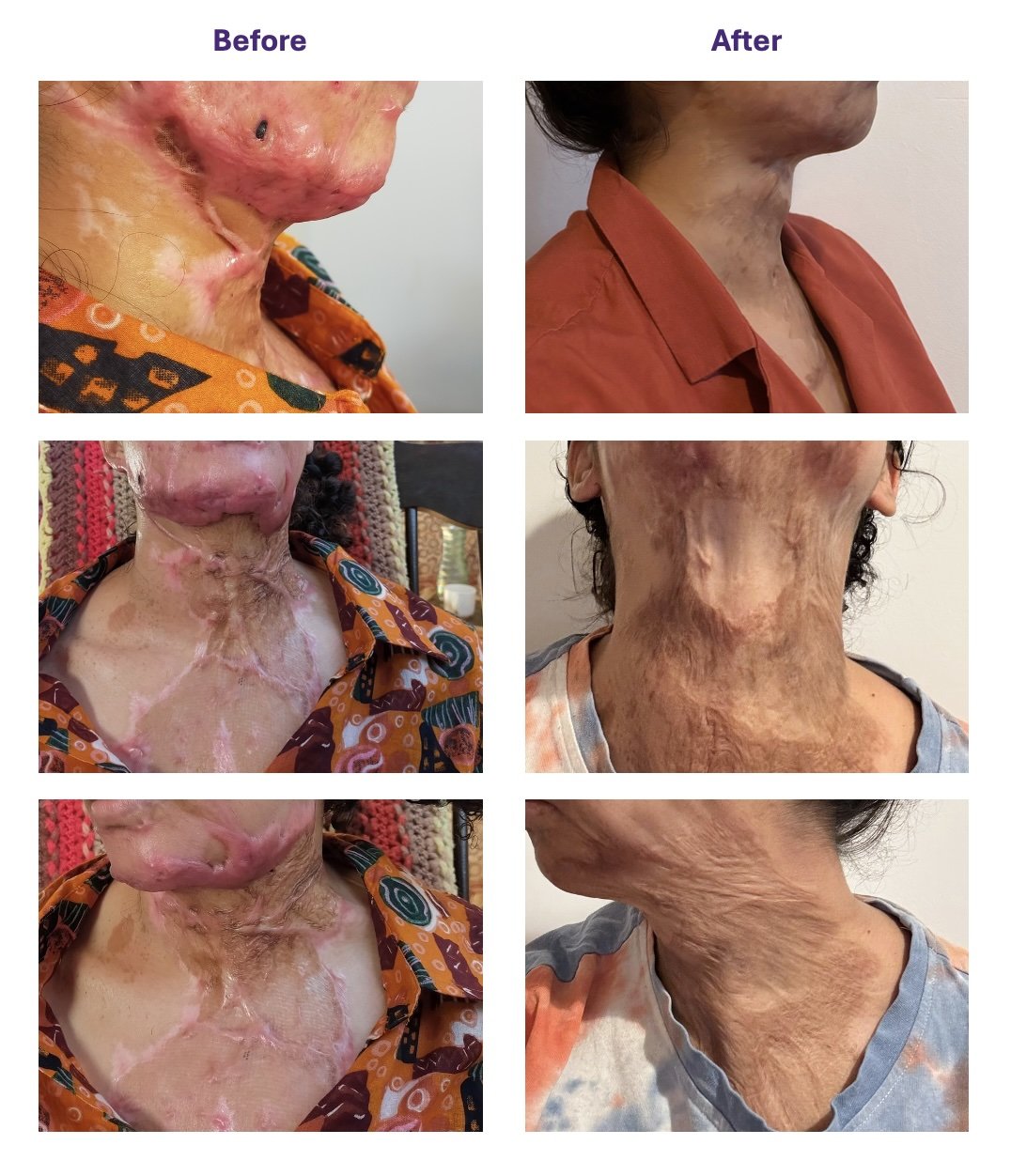
The ‘before’ photographs were taken at the initial assessment, and the ‘after’ photographs from similar angles to illustrate improvements in scar quality and show the available range of neck movement (turning to the right, and looking up as much as possible). These were taken during clinical appointments rather than under standardised photographic conditions, which would be ideal. No makeup or camouflage products were worn in either set. All photographs are shared with the patient’s full consent.
Presenting problems
When we first met, she was requiring substantial pain medication and had very limited neck movement. The ‘before’ photographs show her maximum ability to look upwards towards the ceiling and turn her head to the right.
Scarring around her neck and lower face was also pulling down on her lower eyelids.
Clinical assessment and findings
The scars showed changes across many of the characteristics assessed during a scar examination, including texture, colour, height and vascularity.
The neck scars had very limited pliability and mobility, restricting movement. Pain was also a significant problem. Scarring around the neck and lower face contributed to the downward pull on her lower eyelids.
Scar management
I worked closely with my colleague, a plastic surgeon, throughout her rehabilitation. His treatment formed a substantial part of her wider scar management.
My input included input into managing pressure therapy and improving scar pliability, mobility and range, initially using manual scar mobilisation and later incorporating LPG, a mechanical method of tissue mobilisation. Stretching, home exercises and an ongoing home care programme were also important parts of treatment.
This was a demanding programme requiring considerable time, effort and persistence from the patient, often when it was inconvenient and uncomfortable.
Outcomes
She now has full neck movement, and has no pain.
Earlier improvements in neck scar pliability reduced the pull on her lower eyelids, and the planned surgery to release them was no longer required.
The later photographs show substantial improvements in scar texture, colour, height and vascularity. The plastic surgeon’s treatment made a major contribution to these improvements, alongside scar rehabilitation, her own sustained efforts and scar maturation over time. In this case, scar maturation alone would not have produced an acceptable outcome.
She continues to receive input, illustrating the long-term rehabilitation needs that can follow a burn injury.
What can we learn from this case?
Close working between members of the treating team is very important. In this case, working alongside the plastic surgeon helped us support her and coordinate treatment around her changing needs. The outcome reflects the combined contribution of different treatments and areas of expertise.
Scarring in one area can affect another. Improving the pliability of the neck scars reduced the downward pull on the lower eyelids. This demonstrates why assessment needs to consider how scarring affects surrounding tissues and structures, beyond the immediate site of the scar.
The patient’s determination, attitude and supportive environment were central to her progress. She persevered with a demanding programme, often despite discomfort and inconvenience. Her recovery reflects both the specialist care she received and the sustained commitment and support that helped her put that care into practice.